Flow Meters: Types, Working Principles and How to Choose
A flow meter measures how much fluid passes a point in a pipe — either as an instantaneous rate (m3/h, L/min, kg/h) or as an accumulated total on a totaliser. The detail that matters when specifying one is that almost no flow meter measures volume directly. Most infer velocity and multiply by the known cross-sectional area of the bore. A few measure mass. A few count discrete parcels of liquid. Accuracy class, turndown, straight-run requirement and cost all follow from which of those three the instrument is actually doing.
Rate, total, velocity and mass are four different numbers
Be clear about which number the plant needs before comparing technologies. Specifying the wrong one is a more expensive mistake than picking the wrong principle.
| Quantity | Typical unit | Who actually needs it |
|---|---|---|
| Volumetric flow rate | m3/h, L/min, L/s | Control loops, low-flow and high-flow alarms, pump protection |
| Totalised volume | L, m3, kL | Billing, effluent returns, batch records, groundwater abstraction returns |
| Mass flow | kg/h | Dosing by weight, blending recipes, hydrocarbon accounting |
| Velocity | m/s | Sizing checks and cross-verification |
A volumetric meter that displays kg/h is applying a density figure, not weighing anything — fine for a liquid of stable density, misleading for one whose temperature swings. The electromagnetic flow meter offers L, m3, kg and kL as user-configurable units.
The measuring principles worth knowing
Electromagnetic: the default for water and conductive liquids
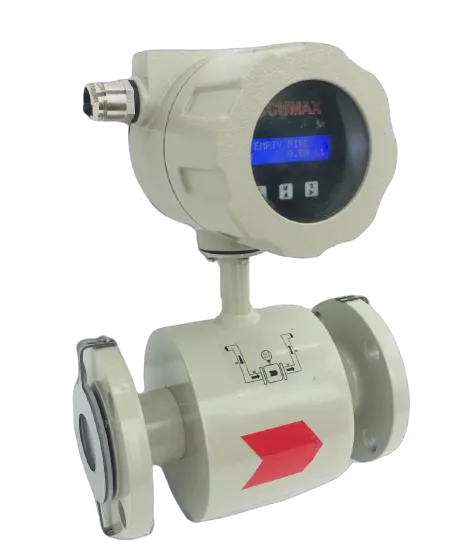
A coil around a lined tube creates a magnetic field across the bore. Moving conductive liquid acts as the conductor cutting that field, and electrodes in the tube wall pick up the induced voltage, which is proportional to mean velocity. Nothing sits in the flow path, so there are no moving parts to wear and no added restriction to create a permanent pressure loss.
The single hard requirement is conductivity. Raw water, treated water, effluent, sewage, most acids and most water-based process liquids conduct easily; demineralised water, RO permeate, oils, solvents and hydrocarbons may not. The Accumax electromagnetic flow meter is specified for conductive liquid at 20 µS/cm or above for water. If you cannot state your conductivity, measure it before specifying anything.
Documented range and build: line sizes 15 NB to 350 NB, flow measuring range 0.2 m3/h to 1300 m3/h, PTFE (Teflon) or rubber (neoprene) liner, SS316L or Hastelloy C22 electrodes, SS304 or SS316 flow tube, flange end connection, protection class IP66/IP67/IP68, process pressure 20 bar, outputs 4-20 mA, RS485 and pulse. It reads forward and reverse flow, reverse shown by a minus sign, and carries an empty-pipe alert. Calibration is wet, at an IEC/ISO/EN 17025 accredited laboratory. Flameproof and potentially-explosive-atmosphere construction standards (IS/IEC 60079-1:2007 and IS/IEC 60079-0:2004) are named in the datasheet’s key features, and ISO 4064:2014 is listed under other approvals.
Ultrasonic transit time: no bore obstruction, battery service
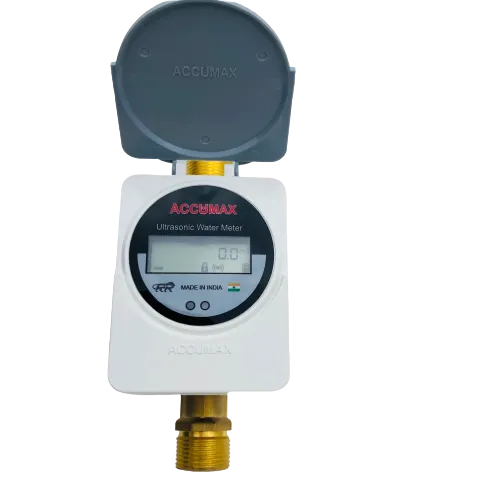
Two transducers fire pulses diagonally across the stream, one with the flow and one against it. The pulse travelling downstream arrives sooner, and the difference in transit time scales with mean velocity. Nothing intrudes into the bore and conductivity is irrelevant, which is why ultrasonic covers liquids a magnetic meter cannot. The trade-off is signal quality: heavy solids loading and entrained air scatter the pulses.
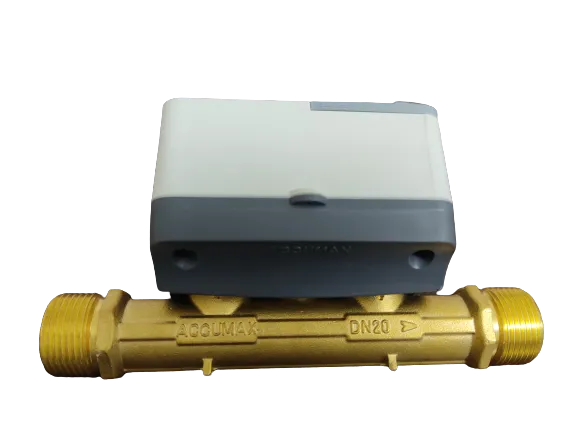
The Accumax ultrasonic water meter and ultrasonic AMR meter both use transit-time technology at accuracy Class 2/B, IP68, 1.6 MPa maximum working pressure, temperature grade T30/T50/T90 — the water meter in DN15, DN20 and DN25, the AMR meter in DN15 to DN40, temperature grade T30/T50/T90, running from a 3.6 V lithium cell at under 0.2 mW with an in-built data logger and five alarm indications. Battery life on the water meter is quoted up to 10 years. The AMR unit adds M-Bus and RS485 on EN1434, Modbus and CJ188 protocols, plus LoRa at 868 MHz. A variant with an integrated flow control valve is also listed.
Turbine: hydrocarbons and clean non-conductive liquids
A rotor sits in the stream and spins at a rate proportional to velocity; a pickup turns rotation into pulses, and a K factor converts pulses into volume. Because it is a mechanical element in the flow, it wants clean liquid, it wears, and it is sensitive to viscosity changes.
The Accumax turbine flow meter is specified at ±1% FS, sizes 15 to 100 NB, for liquid service on oil, solvent, diesel and chemical duty, liquid density 700 to 1300 kg/m3. MOC is SS 304 or SS 316 to suit the application, rotor SS 410, connection flanged or TC end, pressure up to 30 kg/cm2, temperature up to 70 deg C, output 4-20 mA and RS485 Modbus. Its published minimum flows show where a turbine stops resolving:
| Pipe size | 15 NB | 25 NB | 40 NB | 50 NB | 65 NB | 80 NB | 100 NB |
|---|---|---|---|---|---|---|---|
| Min. flow (m3/h) | 0.2 | 0.8 | 1.9 | 3.5 | 5.8 | 7.5 | 14 |
The manual is direct about upkeep: fit a strainer before the sensor, and clean it periodically.
Paddle wheel: the low-cost insertion route
Only a small rotor at the pipe wall turns, driven by part of the stream rather than all of it. That makes it cheap and easy to retrofit through a tee, and it makes the reading dependent on a predictable velocity profile at the probe — which is why straight run matters more here, not less.
The Accumax paddle wheel flow meter starts at 25 NB with accuracy of +2% FS, as full-bore turbine type in 25 NB and 50 NB and as insertion type for 40, 50, 65, 80 and 100 NB. Housing is GF nylon, impeller polypropylene, bearing ceramic ball, pin and shaft carbide or ceramic. Note the envelope: maximum 5 kg/cm2 and up to 50 deg C — a water-service instrument, not a hot or high-pressure one. Each fitting is individually calibrated and marked with a K factor in ml/pulse, and the recommended straight run is 10D upstream and 5D downstream.
Vortex, Coriolis, differential pressure and positive displacement
Named here so you can rule them in or out early.
- Vortex. A bluff body sheds vortices at a frequency proportional to velocity. Strong on steam and gas; needs a minimum Reynolds number, so low-flow turndown is limited.
- Coriolis. A vibrating tube deflects under the Coriolis force, and the phase shift gives true mass flow plus density. Highest accuracy available, highest cost and installed weight.
- Differential pressure — orifice, venturi, nozzle, pitot. Flow follows the square root of the pressure drop across a restriction. Modest turndown and permanent pressure loss, but it works on nearly anything and can be repaired anywhere; a venturi recovers more pressure than an orifice plate.
- Positive displacement. Counts parcels of fluid. Excellent on viscous liquids, poor on abrasives.
Which principle for which liquid
| Service | Reasonable first choice | Reason |
|---|---|---|
| Raw water, treated water, ETP and STP effluent | Electromagnetic | Conductive, often solids-bearing, full bore |
| Slurry, pulp, lime, mineral tailings | Electromagnetic with a liner chosen for abrasion | Nothing in the bore to jam or wear |
| Acids, caustics, aggressive chemicals | Electromagnetic, liner and electrode matched to chemistry | Wetted parts are a choice, not a fixed material |
| Demineralised water, RO permeate | Measure conductivity first; ultrasonic if it is too low | A magnetic meter will not read below its conductivity limit |
| Diesel, oil, solvent | Turbine | Non-conductive and clean |
| Small-bore water metering with remote reading | Ultrasonic AMR | Battery powered, IP68, LoRa or M-Bus |
| Cooling-water branch retrofit | Paddle wheel insertion | Taps an existing line without cutting the main |
| Steam or gas | Vortex or differential pressure | Compressible service |
Six questions that settle the selection
- What is the conductivity? The first gate. Below the meter’s stated minimum, electromagnetic is out regardless of every other merit.
- What is the real flow range, not the pump curve? Size on the flows the plant runs at, including night minimums. The Accumax electromagnetic flow chart carries a useful rule of thumb: minimum flow is in general 5% of maximum flow.
- Will the pipe be full at all times? Electromagnetic and ultrasonic meters both assume a full bore. A partially filled line reads nonsense, whatever the accuracy class says.
- Solids, abrasion, entrained air? Solids rule out turbine and challenge ultrasonic. Air should be engineered out of the location rather than compensated for.
- What has to happen to the reading afterwards? A 4-20 mA loop to a PLC, a pulse to a batch controller, RS485 Modbus into a logger, and telemetry to a cloud dashboard are four different orders.
- Where does it physically go? Straight lengths, valve clearance and pump position are what force a late design change. Check them first.
What sits downstream of the meter
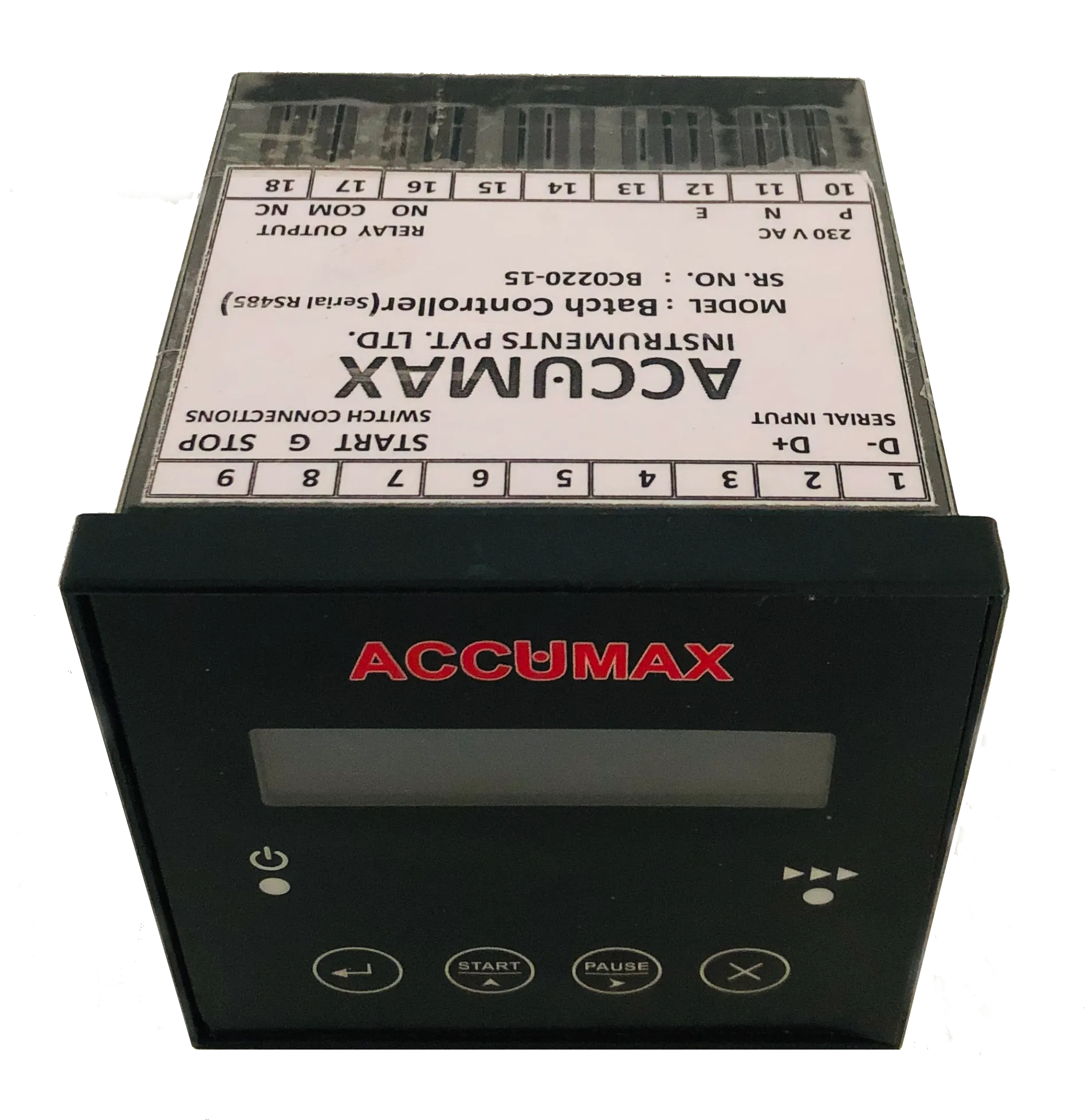
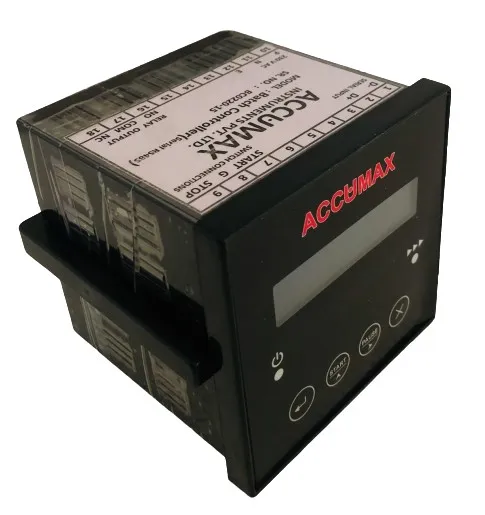
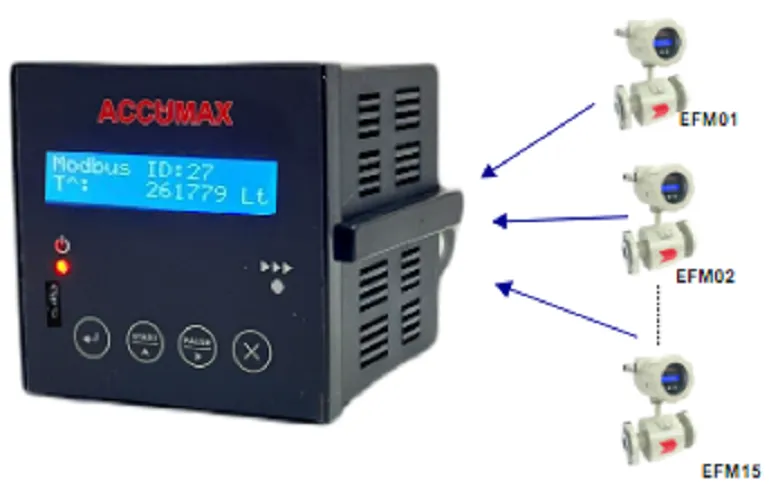
The meter is rarely the whole order. The same RS485 or pulse output can feed a flow totalizer, a remote indicator mountable up to 1 km away, a data logger that reads up to 15 devices over RS485 Modbus and writes CSV files to an SD card, or a controller. The universal flow controller is documented with six operating modes — Totalizer, Batcher, Flow comparator, Rate Switch, Pulsar and PID controller. Where one function is all that is needed there are dedicated units: a batch controller, a flow comparator, a flow control switch, a dosing controller and an IoT device gateway. Ask the supplier to confirm which modes a specific controller model exposes before ordering against a mode name.
Installation decides more of your accuracy than the datasheet does
The recurring rules across the Accumax manuals belong on the piping drawing, not in a commissioning report:
- Allow 10 DN upstream of the meter after a T-connection.
- Keep 5 metres between the axis of the flow meter and the axis of a gate valve located downstream.
- Always install the sensor downstream of the pump and never upstream, to avoid vacuum.
- On horizontal pipes, the converter or junction box goes on the upper part.
- Prefer a vertical or inclined pipe with upward flow direction, and avoid vertical pipes with a free outlet.
- Paddle wheel: 10D upstream and 5D downstream for best results.
- Turbine: strainer before the sensor, and periodic cleaning.
Questions worth asking before the purchase order
These are better obtained in writing than assumed.
- Accuracy and repeatability for your line size and flow range. The electromagnetic datasheet prints these rows but the figures are not legible in the circulated copy; ask for them against your duty point.
- Ambient temperature range, as distinct from medium temperature range, for a transmitter in an unshaded outdoor location.
- Minimum and maximum flow per pipe size for the paddle wheel, and its ingress protection rating, neither of which is published.
- The certificate behind an approval. Flameproof construction standards are named on the electromagnetic datasheet but no certificate or approval number is shown. For an audit, ask for the document, not the standard number.
- The datasheet revision. Published specifications are pending engineering sign-off, so confirm every figure above against the revision quoted for your order.
Take those five questions and a conductivity reading into the vendor call, and the selection usually settles in one conversation.