Smart Water Metering: Where AMR Actually Pays for Itself
Smart metering earns its place in exactly three ways. It recovers water you are losing but not measuring. It removes the cost and the error of walking a route with a clipboard. And it gives you a timestamped record you can put in front of a customer who disputes a bill. If none of those three is costing you real money today, a good mechanical meter read monthly is a perfectly defensible engineering decision, and nobody should talk you out of it.
This article is about working out which of the three applies to you, and what to specify once one of them does.
What “smart metering” actually means
Four quite different things are sold under the same phrase, and the capital and running costs differ by an order of magnitude between them.
| Approach | How the reading leaves site | Practical read interval | What it actually buys |
|---|---|---|---|
| Manual reading | A person visits and writes it down | Monthly or quarterly | Lowest capital cost, nothing else |
| Walk-by / drive-by AMR | Short-range radio to a handheld or vehicle | Monthly, but fast and error-free | No transcription error, no access problems, no dog |
| Fixed-network AMR | Meter to a collector over LoRa or similar | Daily or better | Leak detection, alarms, no site visit |
| Cellular or IP telemetry | Meter or gateway pushes to a cloud service | Configurable, down to minutes | Near real-time alarms, exception-based operation |
The jump that changes how you operate is the third row, not the second. Walk-by AMR is a labour saving. Fixed-network and telemetry are an information change: you stop asking “what did it read” and start asking “which of my 400 meters is behaving oddly”.
Non-revenue water: the part that pays
Non-revenue water is the gap between what you put into a system and what you bill for. The standard way to break it down — the IWA-style water balance — splits that gap into two families, and they need entirely different responses. Do not accept a headline loss percentage from anybody, including a vendor; the only number that matters is the one from your own balance, on your own system.
Apparent losses: the meter is the leak
Apparent losses are water that physically arrived at the customer but was never correctly counted. Under-registration is the big one. Any meter with a moving element wears, and wear shows up first as under-reading at low flow — which is precisely where a large part of domestic and light-industrial consumption sits. A fleet of ten-year-old mechanical meters is quietly a fleet of meters that reads low.
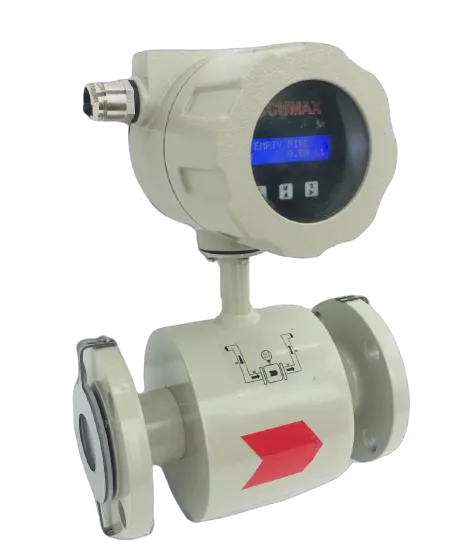
Static measurement principles have nothing in the flow path to wear. The Accumax electromagnetic flow meter is a full-bore design with no moving parts and no pressure drop, and its sensing depends on the liquid being conductive — the datasheet specifies electrical conductivity of at least 20 µS/cm for water. That conductivity requirement is the constraint to check first: demineralised water, most hydrocarbons and many solvents will not work on an electromagnetic meter at all, whatever the brochure says about accuracy.
One setting worth understanding before you commission anything: the low-flow cut-off. On the Accumax electromagnetic meter it is user configurable from 0 to 10 %. Below the cut-off, flow is reported as zero. That is essential for stopping a meter from totalising electrical noise on a still pipe, and it is also a way to accidentally stop billing for a whole class of small draws. Set it deliberately, record what you set, and check it during audits.
Real losses: your leak detection is only as good as your read interval
Real losses are physical leakage. A monthly manual read cannot find a leak — it can only tell you, four weeks late, that one existed. Daily or hourly data lets you use minimum night flow: in a district metering area that should be near-idle at 03:00, a persistent non-zero flow is a leak, and you know it within a day rather than a quarter.
What you need from the instrument to do this at all:
- Reverse flow recorded separately. The Accumax electromagnetic meter indicates reverse flow with a minus sign before the flow rate, and can be set to forward, reverse or bidirectional. It holds positive, negative and delta totalisers.
- Empty pipe detection. An empty pipe alert is available on the electromagnetic meter and can be enabled or disabled. A meter reporting flow on an empty pipe corrupts every downstream calculation.
- Local alarm output. The electromagnetic meter provides a low and high flow alarm on an open-drain output, rated to a maximum of 50 mA DC, which will drive a buzzer, LED or relay directly.
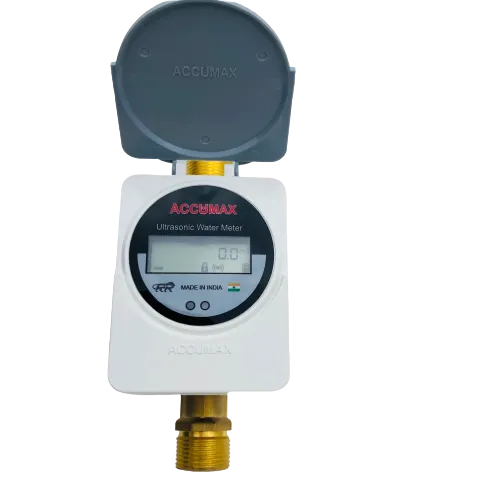
- Alarms carried to the server. The ultrasonic AMR meter carries five alarm indications and an in-built data logger for history. The digital flow meter with telemetry is built to CGWA guidelines, which specify that the meter detect leak, zero (no) flow and high flow, record reverse flow separately, and report a tamper alarm to the server.
The real cost of manual reading
The wage bill for a meter reader is the visible cost and usually the smallest one. The costs that actually hurt:
| Failure mode | What it does to the business |
|---|---|
| No access on the day | Estimated bill, then a corrected bill, then a complaint |
| Transcription error | Wrong bill, credit note, lost trust, staff time |
| Fixed read cycle | Every meter read at the same rate whether it matters or not |
| Reader safety and site access | Confined spaces, chambers, live plant, night access |
| No intermediate data | A four-week hole in which anything can happen |
AMR removes the first two outright. Fixed-network AMR removes the third: you read everything daily and only send a human where the data says to.
Billing disputes
A disputed bill is won or lost on the audit trail. What settles it is a timestamped reading series, a record of reverse flow, a tamper record, and a traceable calibration. The electromagnetic meter is wet calibrated at an IEC/ISO/EN 17025 accredited calibration laboratory, and its datasheet also lists ISO 4064:2014 under other approvals; keep the certificate with the asset record, not in a drawer. Where the meter has password-protected configuration and a password-protected totaliser reset — as the Accumax electromagnetic meter does — record who holds those passwords, because “anyone on site could have reset it” is a losing position in a dispute.
Choosing the measuring principle
| Electromagnetic | Ultrasonic AMR | Turbine | Paddle wheel | |
|---|---|---|---|---|
| Liquid | Conductive liquid, ≥ 20 µS/cm for water | Liquid | Oil, solvent, diesel, chemical; density 700–1300 kg/m3 | Liquid |
| Line sizes | 15 NB to 350 NB | DN15–DN40 | 15 to 100 NB | From 25 NB |
| Flow range | 0.2 to 1300 m3/h | See per-size flow table | See per-size flow table | See per-size flow table |
| Accuracy | See note below | Class 2/B | ±1 % FS | +2 % FS |
| Pressure | 20 bar / 20 kg/cm2 | 1.6 MPa max working | Up to 30 kg/cm2 | Max 5 kg/cm2 |
| Temperature | Medium range per liner; PTFE up to 230 °C, rubber up to 85 °C | Temperature grade T30/T50/T90 | Up to 70 °C | Up to 50 °C |
| Protection | IP66 / IP67 / IP68 | IP68 | See datasheet | See datasheet |
| Output | 4–20 mA / RS485 / pulse | M-BUS, RS485, LoRa 868 MHz | 4–20 mA and RS485 | 4–20 mA and RS485 |
| Power | 85–270 VAC 50–60 Hz or 24 VDC, < 10 VA | 3.6 V lithium, < 0.2 mW | See datasheet | 230 VAC / 24 VDC |
A note on accuracy, because it matters and because guessing would be worse than saying so: the Accumax electromagnetic flow meter datasheet carries an accuracy row and a repeatability row, and the values in the copies available for this article are not legible. Ask for the signed accuracy statement and the calibration certificate before you raise the PO — for any vendor, not only this one. Accumax product pages state that specifications are pending engineering sign-off, so treat the published figures as indicative until you have that document in hand.
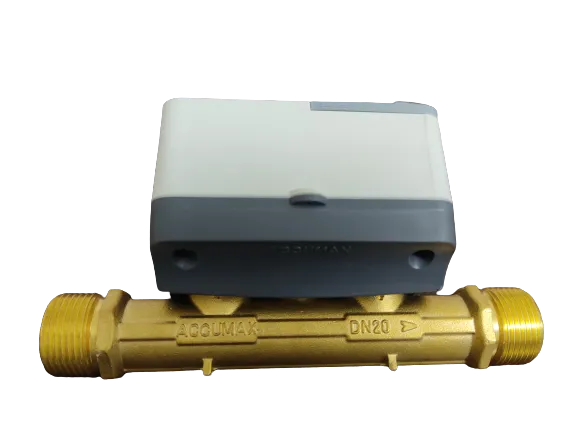
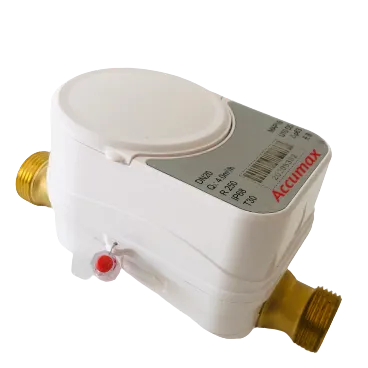
For small-bore utility and sub-metering applications the battery-powered transit-time meters are the sensible fit. Transit-time ultrasonic measurement, as a general class, derives velocity from the difference in ultrasound travel time with and against the flow, so there is nothing in the bore to foul or wear. The ultrasonic water meter is quoted with battery life up to 10 years at < 0.2 mW consumption; the AMR variant with a flow control valve is supplied with an integrated flow control valve — confirm with Accumax whether and how the valve can be actuated from the server before you design a prepaid or defaulter-management scheme around it. For process lines, dirty water, effluent and anything above DN40, the electromagnetic meter is the one to price.
Getting the data off site
| Bearer | Where it fits | Watch out for |
|---|---|---|
| RS485 Modbus | In-plant, meter to logger or PLC | Cable runs, termination, one master |
| LoRa 868 MHz | Distributed meters, utility estates | Gateway coverage and siting |
| GPRS / cellular | Isolated single assets | SIM life, signal at the chamber |
| LAN | Meters inside an existing IP network | Nothing much; use it if you have it |
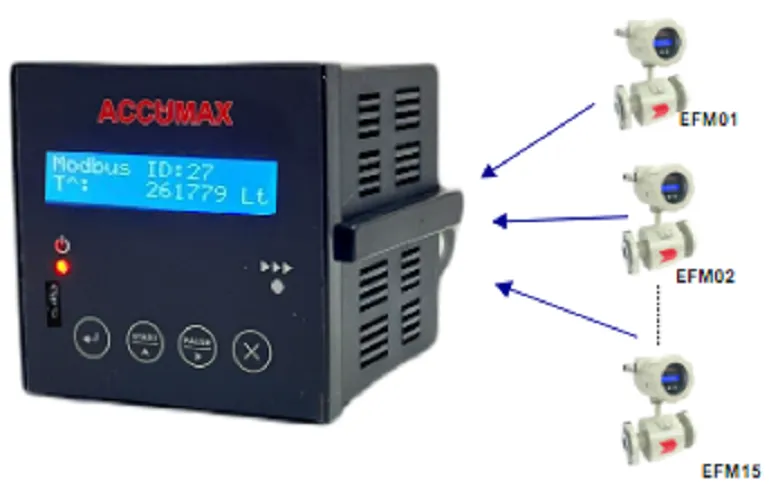
For a plant that just needs a defensible record rather than a cloud, the data logger for flow meter polls up to 15 devices over RS485 Modbus and writes CSV files to an SD card at a preset interval, recording flow, positive totaliser, negative totaliser and final totaliser against date and time. Flow is stored in litre/hr and totaliser in litres, and files are named in DEVICE ID MONTH YEAR form — 10JAN24, for instance. It is an indoor device in a corrosion-resistant enclosure, powered from 230 VAC or 24 VDC, and rated to 100 % humidity.
Where you do want a dashboard, the telemetry variant of the electromagnetic meter is compatible with GPRS/GPS and provides a cloud application on PC, mobile phone or tablet, with reports, real-time data access, multi-user login and group allocation, in tabular and chart views, including tamper and power failure alerts. The cloud application is a yearly subscription via payment gateways — settle the commercial terms and the data export path in the same conversation as the hardware.
Installation details that decide whether any of this works
More smart metering projects are ruined by pipework than by electronics. For the electromagnetic meter the manual is specific: keep any T-connection at least 10 DN upstream of the flow meter; keep 5 metres between the axis of the meter and the axis of a downstream gate valve; on horizontal pipes mount the converter or junction box on the upper part; prefer a vertical or inclined pipe with upward flow, and avoid a vertical pipe with a free outlet; and always install the sensor downstream of the pump, never upstream, to avoid vacuum. Grounding matters too — there is a built-in third grounding electrode, with optional grounding rings for plastic pipelines and lined metal pipes, and those rings are not included in the delivery.
Before you raise the PO, settle these
- The conductivity of the actual liquid, measured, not assumed.
- The signed accuracy statement and the 17025 calibration certificate for the serial numbers you are buying.
- The straight run genuinely available at each site, surveyed, before sizes are fixed.
- Who holds the configuration and totaliser-reset passwords, and how that is recorded.
- Where the data lands, in what format, and how you get a full export if you change vendor.
- For battery meters, the replacement interval and whether replacement is possible without data loss.
- For subscription dashboards, what happens to historical data if the subscription lapses.