Electromagnetic vs Ultrasonic Flow Meter: How to Choose
The short answer
An electromagnetic meter needs a conductive liquid. An ultrasonic meter does not. In practice that single fact settles most specifications, and every other argument — solids handling, retrofit, line size, cost — only becomes relevant once conductivity is resolved.
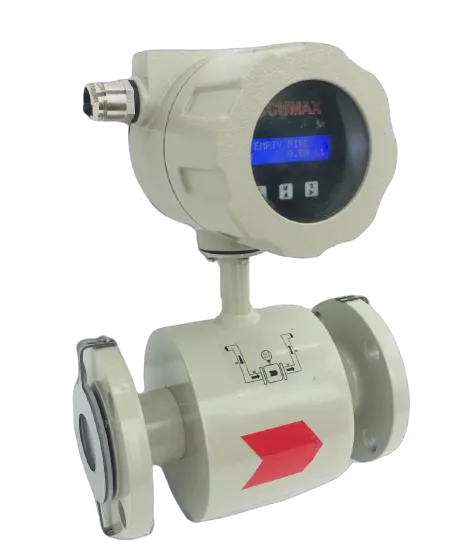
The Accumax electromagnetic flow meter datasheet lists its media as conductive liquid, with an electrical conductivity of >= 20 µS/cm for water. Below that threshold the reading does not simply get noisier; the measurement stops being valid. Borewell water, municipal supply, treated sewage, industrial effluent, brine and most process water sit comfortably above 20 µS/cm. Demineralised water, RO permeate, steam condensate, diesel, solvents and oils do not.
So the first question is not “which technology is more accurate”. It is: what is actually in the pipe, and can I measure its conductivity before I raise the enquiry?
How the two principles differ
Electromagnetic. A coil generates a magnetic field across the bore. A conductive liquid moving through that field acts as a moving conductor and develops a small voltage, which electrodes in the pipe wall detect. Velocity is proportional to that voltage. There is no rotor and no bearing in the bore, so the meter adds no restriction of its own beyond an equivalent length of pipe. The Accumax unit is offered with SS316L or Hastelloy C22 electrodes, a PTFE or rubber (neoprene) liner, and a built-in grounding electrode described in the manual as a third electrode.
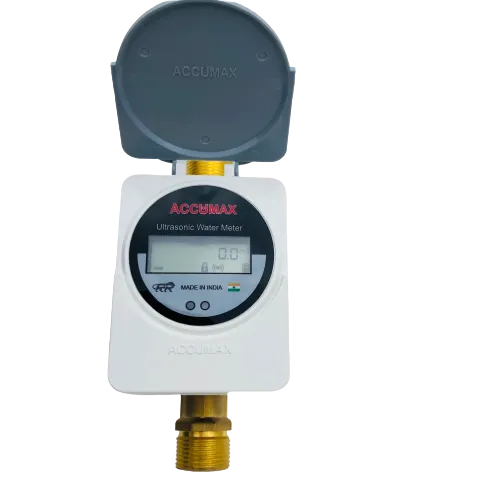
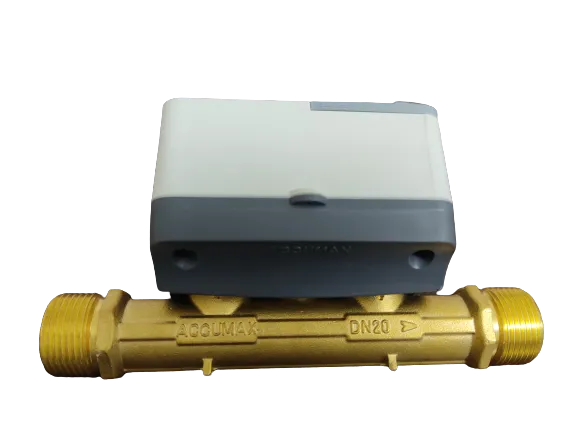
Ultrasonic, transit time. Transit-time ultrasonics — the principle named in the Accumax ultrasonic water meter and ultrasonic AMR meter brochures — times acoustic pulses sent diagonally across the flow in both directions. Pulses travelling with the flow arrive marginally sooner than those travelling against it, and that difference scales with velocity. Nothing in this requires the liquid to conduct electricity. It does require the liquid to carry sound cleanly.
That is the ultrasonic weakness in one sentence. Entrained air, gas bubbles and heavy suspended solids scatter and attenuate the acoustic path. A transit-time meter on a badly aerated line will read erratically or drop out entirely, while an electromagnetic meter on the same line is largely indifferent, provided the pipe stays full.
Side by side: what the two datasheets publish
| Parameter | Electromagnetic flow meter | Accumax ultrasonic meters |
|---|---|---|
| Media | Conductive liquid, >= 20 µS/cm for water | Liquid; no conductivity requirement stated |
| Line sizes | 15 NB to 350 NB | DN15 to DN40 |
| Flow range | 0.2 m3/h to 1300 m3/h | Min. flow 0.00625 m3/h at DN15, rising to 0.04 m3/h at DN40 |
| Accuracy | Label present in the datasheet table, value not recoverable — request it | Class 2/B |
| Power | 85 VAC–270 VAC 50/60 Hz or 24 VDC, <10 VA | 3.6 V lithium cell, consumption <0.2 mW |
| Protection | IP66 / IP67 / IP68 | IP68 |
| Pressure | 20 bar (20 kg/cm2) | 1.6 MPa maximum working pressure |
| Temperature | Medium range −10 (0) °C to +200 °C; PTFE to 230 °C, rubber to 85 °C | Temperature grade T30/T50/T90 |
| Outputs | 4-20 mA / RS485 / pulse | M-Bus, RS485 and LoRa 868 MHz on the AMR variants |
| Protocols | Modbus over RS485 | EN1434, Modbus, CJ188 (AMR variants) |
| Hazardous area | Flameproof (IS/IEC 60079-1:2007) / weatherproof / can function in potentially explosive atmosphere (IS/IEC 60079-0:2004) | Not stated |
| Calibration | Wet calibrated at IEC/ISO/EN 17025 accredited calibration laboratory | Supplied calibrated from the plant (documented for the AMR meter with control valve) |
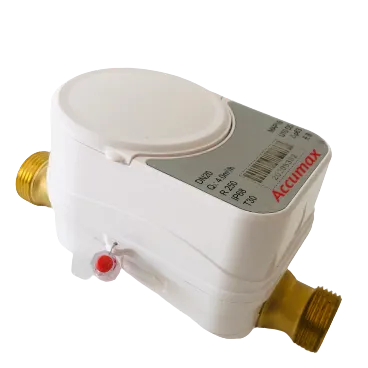
The ultrasonic column draws on three related products — the water meter, the AMR meter and the AMR meter with control valve — which do not share every specification. Check the individual datasheet for the variant you are specifying. Figures are taken from the current Accumax datasheets and are subject to engineering sign-off. Confirm against the datasheet issued with your quotation.
Two rows in that table do more specification work than the rest combined. The line size row means the Accumax ultrasonic range stops at DN40, so anything above roughly 50 NB is an electromagnetic conversation by default. The power row means the ultrasonic meters run on an internal lithium cell, which removes the cable, the conduit and the trench from the scope of supply — decisive at a remote borewell or a scattered estate metering scheme.
Dirty fluids, and where each one actually fails
Electromagnetic meters tolerate solids well. Sewage, primary effluent, lime slurry, pulp stock and abrasive tailings are routine service for them, because nothing intrudes into the bore to wear or foul. The failure modes are different in kind: liner attack by an incompatible chemical, electrode coating by an insulating deposit such as grease or scale, and earthing problems that let stray plant currents swamp a millivolt-level signal.
Transit-time ultrasonic meters fail on the acoustic path. Air entrainment from a leaking pump gland, a cascading tank inlet or a partially drained line will do it. So will very high solids loading, and so will a scaled internal bore that changes the acoustic geometry away from the calibrated one. On clean water — which is what the Accumax ultrasonic range is built for — none of that arises.
A useful heuristic: if the line is dirty, choose electromagnetic. If the line is clean but non-conductive, ultrasonic or a turbine flow meter. If the line is dirty and non-conductive, the specification is hard and you should be talking to an application engineer rather than reading a comparison article.
Retrofit, clamp-on and the question you must ask
The usual argument for ultrasonics is that a clamp-on transit-time meter straps to the outside of an existing pipe, needs no cut, no flange and no shutdown. That is a real advantage of the clamp-on form factor as a technology, and it is why clamp-on units dominate temporary surveys and audit work.
Be careful about carrying that advantage across to a specific product. The Accumax ultrasonic products documented here are inline meters: the ultrasonic AMR meter and the ultrasonic AMR meter with flow control valve at DN15 to DN40, and the ultrasonic water meter at DN15, DN20 and DN25. Their datasheets describe inline instruments, not clamp-on transducer sets. If you need a clamp-on or strap-on solution, ask Accumax directly whether one is offered and on what pipe materials and wall thicknesses; that is not something the published documentation answers.
The electromagnetic meter is unambiguously an inline, flange-end instrument. Process connection is flange end, with MS, SS304 or SS316 flanges in class 150, 300 or 600. There is no retrofit-without-cutting option.
Full bore versus insertion
Full bore means the meter body is the pipe for that length: the whole cross-section is measured. Insertion means a probe enters the line through a tapping and samples velocity at one point, which is then scaled by an assumed velocity profile. Insertion is cheaper at large diameters and can often be fitted under a hot tap, but it inherits every profile error the installation creates, so it needs more straight run and more care.
Within the Accumax range the split is documented on the mechanical meters. The paddle wheel flow meter is offered as a full-bore turbine type at 25 NB and 50 NB, and as an insertion type for 40, 50, 65, 80 and 100 NB line sizes, with a fitting that sets the probe at the correct depth and orientation. Insertion-type sensors are also available with solvent-cementable adaptors for PVC tees. The electromagnetic meter is full bore across 15 NB to 350 NB.
What drives the cost of each
No prices here — they move, and they depend on your configuration. But it is worth knowing which line items you are actually choosing between.
| Cost driver | Electromagnetic | Ultrasonic (Accumax range) |
|---|---|---|
| Line size | Scales steeply; a 350 NB body is a large casting with a large coil | Fixed narrow range, DN15–DN40 |
| Material selection | Liner (PTFE, hard rubber, polyurethane), electrode (SS316L or Hastelloy C22), flange class all priced separately via the ordering code | Not a configurable dimension in the published brochures |
| Site power | Needs 85–270 VAC or 24 VDC; cable, conduit, trench and possibly a UPS | Internal 3.6 V lithium cell |
| Civil and mechanical work | Cutting, flanging, spool piece, supports, straight run | Same inline work, but at small bore |
| Communications | 4-20 mA, RS485 or pulse; wiring back to the panel | LoRa 868 MHz on the AMR meter removes the cable run |
| Recurring | Telemetry cloud application is a yearly subscription on the telemetry variant | Ask what the AMR head-end costs to run |
| Recalibration | Wet calibration at an accredited laboratory; the meter must come out of the line | Same consideration; ask about the procedure |
Decision table by application
| Application | Usually the right choice | Reasoning |
|---|---|---|
| Borewell abstraction with CGWA reporting | Either — the guideline document Accumax works to names ultrasonic or electromagnetic as acceptable metering technology | Selection then falls to line size, power availability and telemetry. See the digital flow meter with telemetry system |
| ETP / STP outlet, MEE feed, sludge transfer | Electromagnetic | Conductive, dirty, sometimes abrasive; nothing in the bore to foul |
| Process line on oils, solvents, diesel, chemicals | Neither, in most cases — consider the turbine flow meter | Non-conductive rules out electromagnetic; the turbine datasheet names oil, solvent, diesel and chemical service, with a liquid density of 700–1300 kg/m3 |
| Bulk water supply, apartment and estate sub-metering at DN15–DN40 | Ultrasonic AMR | Battery powered, IP68, LoRa, in-built data logger, LCD 8 digit display |
| Large bulk transfer above 50 NB | Electromagnetic | The documented Accumax ultrasonic range stops at DN40 |
| Hazardous or flameproof area | Electromagnetic | It is the only product in this comparison whose datasheet names IS/IEC 60079-0 and 60079-1 construction |
| Cooling water, RO permeate, DM water | Ultrasonic, or turbine | DM water and permeate can fall below 20 µS/cm |
| Existing line that cannot be shut down | Ask before assuming | Clamp-on is a genuine technology answer, but is not documented in the Accumax product literature reviewed here |
Before you release the enquiry
Have these five answers written down. Every one of them changes the selection, and none of them can be inferred from a pipe diameter alone.
- Measured conductivity of the liquid, in µS/cm, at operating temperature — not an assumption from the fluid name.
- Minimum and maximum flow you actually need to measure, not the pump’s rating. Check that the minimum sits inside the meter’s range; the electromagnetic chart notes that minimum flow is in general 5% of maximum flow.
- Whether the line ever runs part-full, and whether air can be entrained upstream.
- Available power at the meter location, and whether it is reliable.
- Which output you will actually consume — 4-20 mA into a PLC, RS485 Modbus into a data logger for flow meter, pulse into a totaliser, or LoRa into a head-end.
One question the published documentation does not answer, and you should put to the supplier in writing: the accuracy and repeatability figures for the electromagnetic meter. Both rows exist in the datasheet’s technical specification table, but the values are not legible in the version reviewed here. Ask for them against your line size and flow range, and ask for the calibration certificate that supports them.