CGWA NOC Requirements for Groundwater Abstraction
If you abstract groundwater for anything beyond ordinary domestic use, you probably need a No Objection Certificate from the Central Ground Water Authority before you sink or continue to operate the borewell. The paperwork is not the expensive part. The expensive part is the condition attached to the grant: a tamper-resistant flow meter with telemetry on every abstraction structure, a water level recorder in the observation well, and data going to a cloud server twice a day for as long as you hold the NOC.
One caveat before anything else, and it is not a formality. The CGWA guidelines have been revised repeatedly, and thresholds, exempt categories, fee structure and validity have all changed between revisions. Several states also operate their own groundwater regulatory bodies, and where one exists it may be the authority you deal with instead of, or in addition to, the central one. Treat everything below as the shape of the requirement, and confirm the current text and the current thresholds with the authority itself before you commit to a design or a budget.
What the CGWA NOC is
The Central Ground Water Authority regulates and controls groundwater development and management in India under powers derived from the Environment (Protection) Act, 1986. Where it has notified or assessed an area, abstraction of groundwater by users other than exempted categories requires prior permission, issued as a No Objection Certificate for withdrawal of ground water. The NOC is not a one-time clearance — it is a permission with conditions attached, and the conditions are continuous.
Who typically needs one
The categories have shifted between revisions, so verify. Broadly, the users who have been brought within the requirement are:
- Industries drawing groundwater for process, cooling or utility use
- Infrastructure and mining projects, including dewatering during construction
- Bulk water suppliers and packaged drinking water units
- Large residential complexes, townships, commercial buildings and institutions on their own borewells
- Government and municipal water supply schemes drawing from groundwater
Individual domestic users have generally been exempt, and agricultural abstraction has been treated separately from industrial abstraction. Neither of those is a safe assumption to build a project on. Check whether your specific use, at your specific volume, in your specific assessment unit, requires an NOC today.
How the area you are in changes the answer
The Central Ground Water Board assesses groundwater at the level of an assessment unit — a block, taluka, mandal or firka — and categorises it by the ratio of extraction to annual recharge:
| Category | Broad meaning | Practical effect on an application |
|---|---|---|
| Safe | Extraction well within recharge | Least restrictive conditions |
| Semi-critical | Extraction approaching recharge | Tighter scrutiny, conservation conditions |
| Critical | Extraction close to or exceeding recharge | Substantial restrictions and obligations |
| Over-exploited | Extraction exceeds recharge | Most restrictive; some uses may not be permitted at all |
The single most useful thing you can do early is establish the current category of the assessment unit your site falls in, because it determines whether the project is straightforward, expensive, or not viable on groundwater at all. That determination belongs at the feasibility stage, not after the civil works.
The broad shape of the application
The process is run online. The stages, in the order they generally occur:
| Stage | What it involves |
|---|---|
| Establish jurisdiction | Confirm whether the central authority or a state groundwater authority handles your case |
| Establish category | Determine the current categorisation of the assessment unit |
| Register and apply | Apply through the authority’s online portal for the relevant NOC type — new, renewal or amendment |
| Supporting documents | Site and land details, borewell particulars and depths, the quantum of water sought, justification of requirement, and details of wastewater handling and reuse |
| Technical scrutiny | Review of the application against the guidelines applicable to that category |
| Hydrogeological input | For larger abstraction, an impact assessment or hydrogeological report may be sought |
| Grant with conditions | The NOC is issued subject to conditions — metering, telemetry, piezometer, recharge measures, reporting |
| Compliance and renewal | Continuous data reporting, periodic returns, and renewal before expiry |
Every one of those stages has current specifics — forms, fee heads, document formats, timelines — that change. Read them off the authority’s own portal at the time you apply and do not rely on a consultant’s copy from last year.
What monitoring equipment the NOC obliges you to install
This is the part with real engineering and real cost in it, and it is the part most applicants underestimate.
The abstraction flow meter
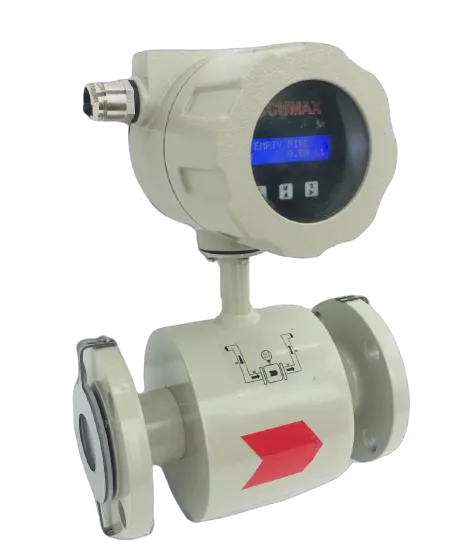
The guideline specification for the metering on an abstraction structure is detailed and prescriptive. The Accumax digital flow meter with telemetry system is built to CGWA guidelines, and the specification it is built to reads as follows:
| Requirement | Specification |
|---|---|
| Metering technology | Ultrasonic or electromagnetic |
| Turndown ratio | 10 or above |
| Accuracy | Better than ±2 % over the operating flow range, from 10 % to 100 % of maximum flow rate |
| Calibration laboratory | Testing or calibration performed at an ISO 17025:2017 accredited laboratory |
| Calibration points | At least 4-point calibration, at 10 %, 40 %, 70 % and 100 % of rated flow |
| Magnetic field immunity | Performance not affected by external magnetic field, as specified in ISO 4064 |
| Mounting plane | Accuracy retained when installed horizontally and/or vertically |
| Manufacturing standard | Preferably manufactured as per ISO 4064:2014 |
| Ingress protection | IP68 |
| Body material | Brass, bronze, MS, SS or engineering plastic, compact enough to resist tampering |
| Indicator cover | Sturdy glass, PP or PC, straight reading type; the indicator cannot be removed from its place if the protective glass is broken |
| Sealing | Mechanical and electronic sealing; any attempt to open the meter or enclosure should physically damage the tag |
| Body markings | Make/brand, nominal size, serial number and year of manufacture, metrological specifications |
Take the turndown requirement seriously at sizing. A ratio of 10 or above, with the accuracy band defined from 10 % of maximum flow, means an oversized meter fails the specification at your actual minimum draw even though it is nominally accurate. Size on the real flow envelope of the pump, not on the pipe you happen to have. Published line sizes and ranges include DN40 at 0.25 lps to 5 lps, DN100 at 3 lps to 30 lps and DN150 at 13 lps to 130 lps, with other line sizes available.
Telemetry and the data path
Metering alone does not satisfy the condition. The data has to leave the site:
| Requirement | Specification |
|---|---|
| Communication | LAN for internet connectivity, or LoRaWAN and/or cellular GPRS |
| Transmission frequency | Minimum twice a day |
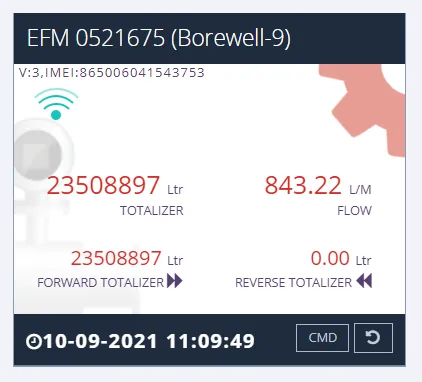
| Parameters transmitted | Timestamp; cumulative forward flow volume; cumulative reverse flow volume; cumulative net volume; cumulative pump working hours; meter serial number; device last calibration date; borewell ID provided by CGWA |
| On-board logging | Daily flow data with timestamp, retained for at least 2 years |
| Store-and-forward | On power cut or weak signal, the meter stores data and transmits when telemetry is live again |
| Loss of communication | Indicated at the server within 48 hours |
| Encryption | Communication encrypted to prevent tampering |
| Cloud provider | Should be empanelled with the Ministry of Electronics and Information Technology (MeitY) |
| Electrical environment | Operates in electrically noisy environments and near high voltage lines |
Power is specified alongside: the meter is to be battery operated or UPS powered with power-off detection, metering data is to be retained even when the telemetry unit is off due to power failure, and where a battery is used it should give at least 3 years at two transmissions per day and be replaceable without data loss, with battery usage indicated at the server.
The MeitY empanelment clause is the one that quietly constrains vendor choice, and it is worth putting in writing as a question during tendering rather than discovering later.
Where the meter goes
The installation conditions are as binding as the instrument specification, and they are where site teams most often create a non-compliance:
- The meter is installed on the borewell pump discharge line, before any branching
- There must be no bypass of pipe prior to the installed flow meter
- The installation must ensure the pipe is full of water at all times, with sufficient upstream and downstream straight length
On that last point, the guideline document refers to a figure rather than stating the straight-length numbers in text, so no figure is reproduced here. Confirm the required upstream and downstream lengths with the authority and with your meter supplier before the pipework is fabricated — this is the change that is cheap on a drawing and expensive in the ground. As a reference for what full-bore metering generally needs, the Accumax electromagnetic flow meter manual asks for any T-connection to be at least 10 DN upstream of the flow meter, 5 metres between the meter axis and the axis of a downstream gate valve, and the sensor always downstream of the pump and never upstream, to avoid vacuum.
Water level monitoring
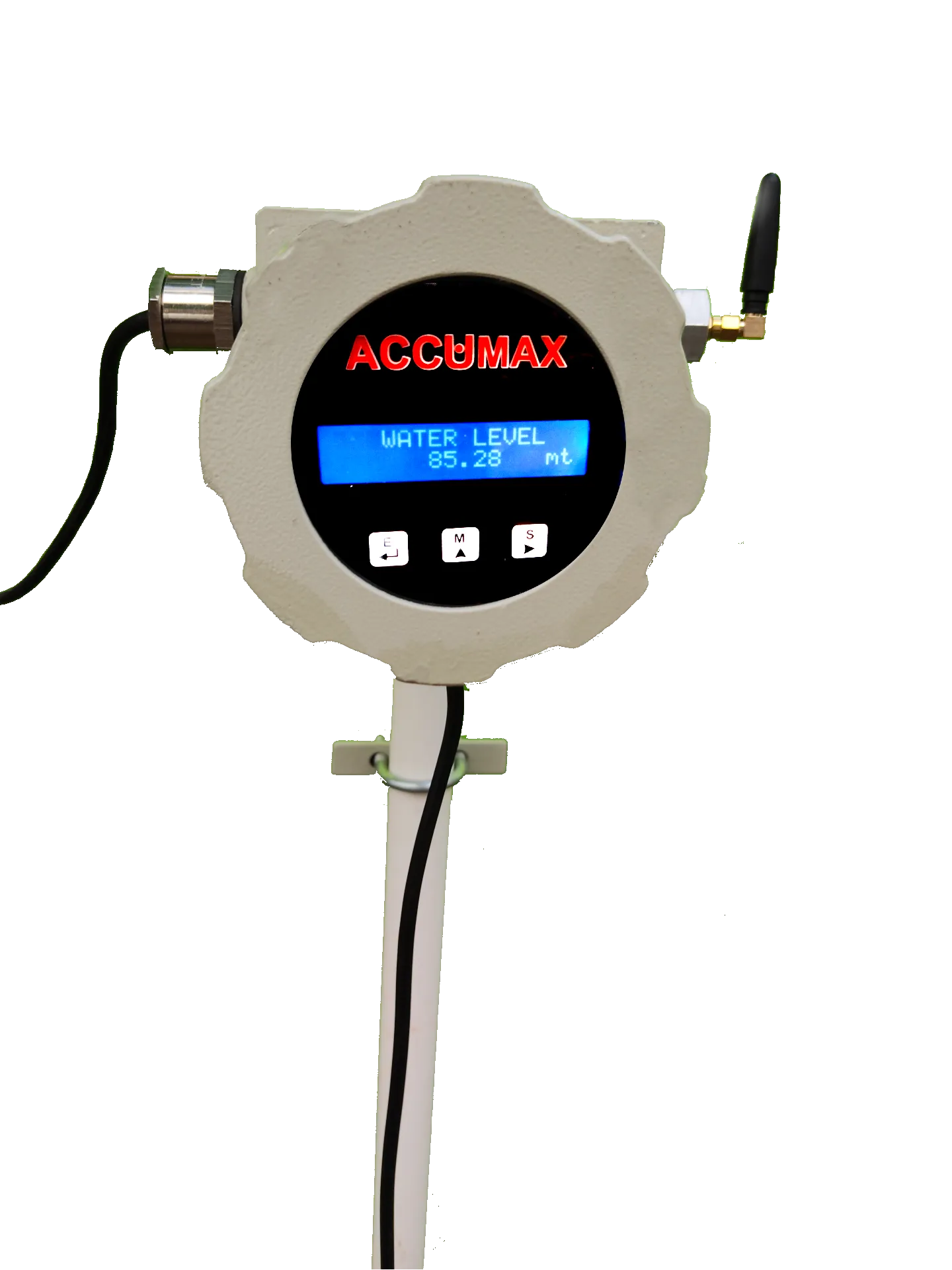
Alongside abstraction metering, NOC conditions commonly require groundwater level monitoring in an observation well or piezometer, so that the effect of your abstraction on the aquifer is recorded rather than argued about. The Accumax piezometer / digital water level recorder is built to CGWA guidelines for borewell installation with an IP68 sensor and optional telemetry.
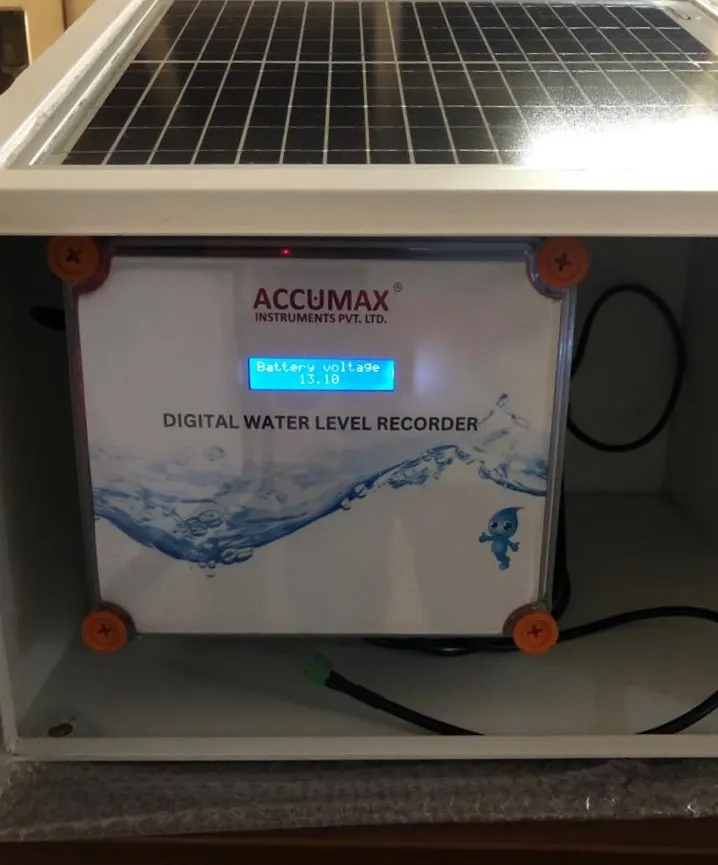
Where the site has no reliable mains, the solar-powered digital water level recorder with telemetry calculates water level from hydrostatic pressure and logs groundwater level, water temperature, atmospheric pressure and atmospheric temperature. Its logged record carries date, time, corrected water level in metres, raw water level, water temperature, atmospheric pressure, atmospheric temperature and battery voltage — battery voltage in the log is more useful than it looks, because it is how you diagnose a station that has stopped reporting. It runs from a rechargeable battery charged by a solar panel, with 48 to 72 hour battery backup, writes CSV files to an SD card at preset intervals, transmits to the server at preset intervals, and its sensor depth, log intervals and error compensation are settable over RS485.
What ongoing reporting looks like
The NOC turns a borewell into a reporting obligation. In practice that means:
- Automatic data, twice daily at minimum, carrying cumulative forward, reverse and net volumes, pump working hours, meter serial and last calibration date, tagged to the borewell ID issued by the authority.
- Alarms raised to the server: leak, zero (no) flow and high flow detection, separately recorded reverse flow, tamper alarms as and when tampered, and real-time battery and tamper alarms.
- Timestamping on every reading, which is what makes the record defensible.
- A management portal with cloud-based web access, separate consumer, engineer and manager screens, database backup and restore, real-time data access, and email or SMS alerts to the user.
- Periodic returns and water audits to the authority, plus renewal ahead of expiry. The formats and periodicity are set by the current guidelines — confirm them.
One thing the guideline text does not settle, and which you should ask about directly: the re-calibration interval for an installed meter, and who is permitted to carry it out. The last calibration date is a transmitted parameter, which strongly implies the authority intends to watch it.
Where compliance most often breaks
- A bypass line left in place from the construction phase, or a branch taken off upstream of the meter for site use
- Insufficient straight run, because the meter was specified after the pipework was built
- A telemetry SIM that lapses, producing a silent station that only shows up as a loss-of-communication flag at the server
- Sealing broken during a pump overhaul and not re-established
- A calibration certificate that is not traceable to an ISO 17025 accredited laboratory, or that covers a different serial number
- Meter oversized at design, so measured flow sits below 10 % of maximum and outside the accuracy band
Before you apply
- Confirm the assessment unit category and which authority has jurisdiction.
- Fix the real flow envelope of each pump, and size the meter to it — not to the pipe.
- Confirm the required upstream and downstream straight lengths in writing, then design the pipework.
- Confirm the meter is on the discharge line before any branching, with no bypass anywhere upstream.
- Ask the vendor for the ISO 17025 accredited 4-point calibration certificate against your serial numbers.
- Ask which cloud service the telemetry lands on and whether the provider is MeitY empanelled.
- Ask for the re-calibration interval and the procedure for maintaining the seal through pump maintenance.
- Plan the observation well and its water level recorder in the same package as the metering, not as an afterthought.